What is the sea, to Busan?
Busan's coastline: 266 kilometers. Over 60% of residents live within 3km of the shore. Is the sea an asset or a backdrop?
18 Questions for Next Busan · Day 4 of 18 Hyunseung Kim (Gray) · May 21, 2026
266 kilometers
Thirteen days until Busan's next mayor is decided.
Yesterday's question: how does a city work with zero top-100 companies?
Today we go into the setting where that work happens.
Busan's coastline: 266 kilometers.
Roughly the distance from Seoul to Daejeon in a straight line. This city holds that much sea.
But what is the sea, to Busan?
What the numbers say
Busan and the sea, spring 2026:
- Total coastline: 266km
- Port of Busan container throughput (2024): 24.4 million TEU — 7th globally, all-time high
- Annual visitors to Busan's five main beaches: approx. 20 million (Haeundae, Gwangalli, Songjeong, Dadaepo, Ilgwang)
- Fisheries production value (2024): approx. ₩1.2 trillion
- Share of Busan's population living within 3km of the coast: estimated 60%+
The sea is everything to Busan.
As a port, as beaches, as industry, as scenery.
Remove the sea from Busan and almost nothing remains.
But what is the sea, actually, to the people who live here?
What I saw in Songjeong
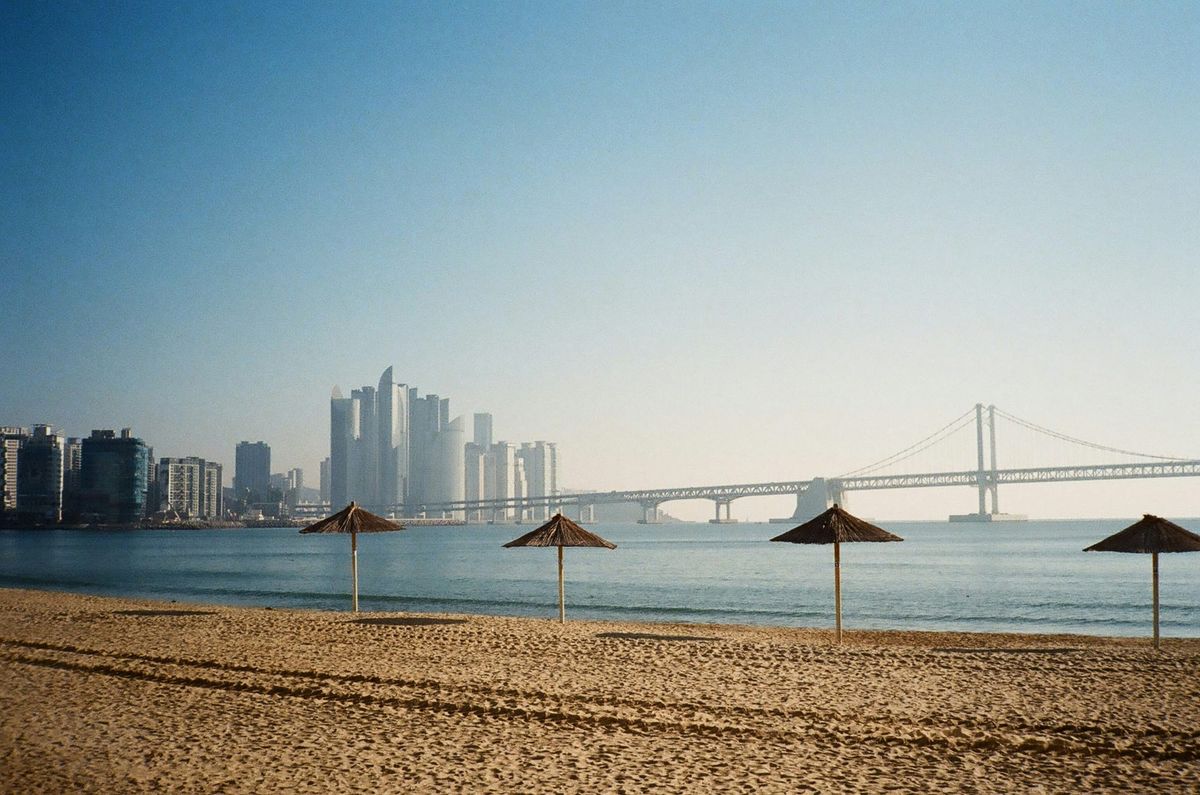
Six in the morning, Songjeong Beach.
One stop east of Haeundae Busan's most famous beach, where tourists gather and high-rise hotels line the shore sits Songjeong, a quieter stretch known among surfers. Cafés line the streets behind the sand. Summers bring crowds, but spring and fall stay calm.
A few people waiting for waves, boards beside them.
I asked one: "Do you come here often?"
"Almost every day."
Every day. At dawn. Before work.
Some portion of Busan's population lives this way. The sea is not scenery it's routine. Morning coffee happens at a beachside café. The post-work walk runs along the shore. Weekend exercise is surfing.
But for most people in Busan, the sea is still somewhere else.
Two seas
Busan has two seas.
First, the working sea
Port of Busan. Gamcheon Port. Namhang. Dadae Port.
Where containers move, seafood trades, ships repair. The heart of Busan's economy. The source of that world-7th-ranking number.
But this sea is separated from daily life. Ports sit behind fences. Cranes are visible from a distance. Containers move only by truck. Citizens cannot enter this sea.
Second, the resting sea
Haeundae. Gwangalli. Songjeong. Dadaepo.
Where people walk, sit, photograph, surf. Where tourists arrive and summer tents line up in rows a distinctly Korean beach culture where families claim patches of sand with shade structures and spend entire days by the water.
But this sea fluctuates sharply by season. Summer: overcrowded. Winter: deserted. Spring and fall: ideal, but only those who know come.
Most Busan residents use the second sea occasionally. The first sea not at all.
The question remains
What is the sea, to Busan?
Asset or backdrop?
If asset citizens should be able to use it more frequently, more closely, more variously. Not just port infrastructure, but citizen access is part of the asset.
If backdrop it stays scenery. A sea visible from a distance. A sea visited occasionally. A sea good for photographs.
A city where more people live like the person waiting for waves every morning in Songjeong and a city where they don't move differently.
How to make "the sea is the center of the city" more than rhetoric how to make it citizens' daily routine.
That is the question the next Busan must answer.
One small ask
Tomorrow, the fifth question.
Three gateways airport, station, port why hasn't Busan become a gateway city?
If something here resonates, share it with one person someone who lives the sea as routine in Busan.
— Gray Busan, May 2026
PolyBusan does not endorse any party or candidate. We just ask questions. Corrections, thoughts: busanloop@gmail.com