How does a city work with zero top-100 companies?
Korea's top-100 companies headquartered in Busan: zero. How does a city work when the number is zero and what ecosystem does that create?
18 Questions for Next Busan · Day 3 of 18 Hyunseung Kim (Gray) · May 20, 2026
Zero
Fourteen days until Busan's next mayor is decided.
Yesterday's question: who stays?
Today's question is about where those people actually work.
Korea's top-100 companies headquartered in Busan: zero.
That number appeared in Q1. It appeared in Q2. Today we go inside it.
What does zero mean. And — how does a city work when the number is zero.
What the numbers say
Work in Busan, spring 2026:
- Korea's top-100 companies headquartered in Busan: zero
- Share of Busan businesses with 300+ employees: under 0.1% (Statistics Korea)
- Share of Busan's workforce in manufacturing: approx. 12% — below the national average of 16%
- Self-employed: 370,000 in 2021 → 289,000 in 2025. A loss of 81,000
- Rate of solo-founder businesses in Busan: above the national average — not by choice, but as a structural outcome
Zero is not just a number.
No major headquarters means no supplier ecosystem. No procurement departments, no legal team contracts, no corporate welfare spending flowing into the local economy. The capillary system of a city's economy — missing.
And yet.
With zero, Busan keeps moving.
What I saw on the 22nd floor of BIFC2
Eight in the morning, the lounge at BIFC2 — a twin-tower complex in the heart of Busan's financial district, built to anchor the city's ambitions as an international finance hub.
Through the windows: the mouth of the Nakdong River and the open sea, simultaneously.
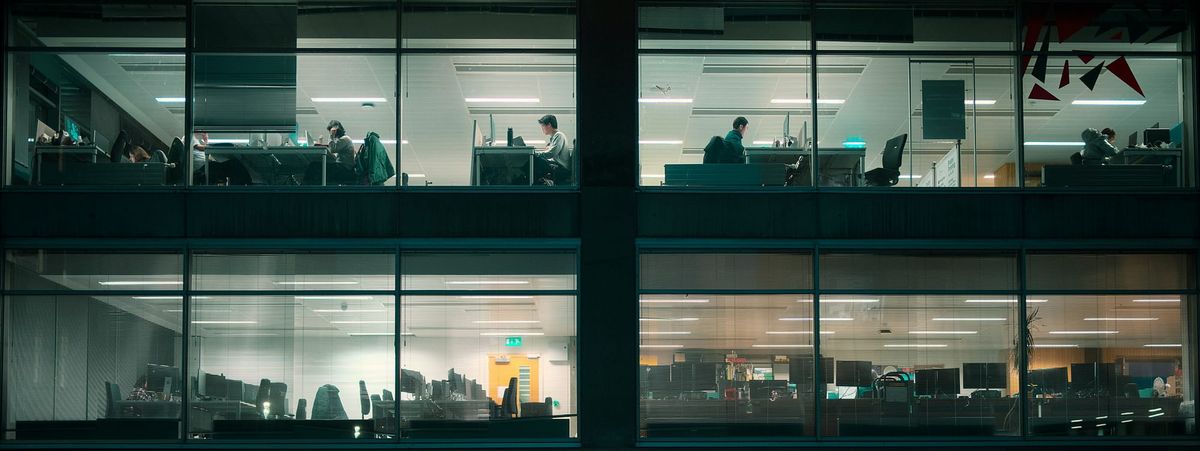
Three people at a table. One is on a video call with an investment firm in Singapore. One has a spreadsheet open, reviewing an import-export contract. One sits with just a coffee — probably waiting for the next meeting.
None of them work for a large company.
One runs a logistics startup. One is a trade broker. The third — I didn't ask. In Busan, that question comes second. What are you building right now tends to arrive before who do you work for.
This is what work looks like in Busan.
Not moving inside a structure designed by a large corporation — but building the structure as you go.
Two readings
"How does a city work with zero top-100 companies?"
Two ways to read it.
First — as a deficit
No large companies means no good jobs. No good jobs means young people leave. Young people leave, consumption drops, self-employment collapses, the city contracts. A structural downward spiral. Not wrong.
Second — differently
No large companies means the space large companies would have filled is still open.
Port logistics. Marine services. Fisheries. Tourism. Content. Busan's core industries have always leaned toward sectors where small operators dominate. A high rate of self-employment signals vulnerability — and also signals low barriers to entry.
Some people, instead of joining a conglomerate in Seoul, chose to build something directly in Busan. Like the person at the Jeonpo craft beer bar yesterday.
What ecosystem does that accumulation of choices create. What kind of work does it leave for the next generation.
That is the question Busan has not yet answered.
One small ask
Tomorrow, the fourth question.
What is the sea, to Busan?
If something here resonates, share it with one person — someone building their own structure in this city.
— Gray Busan, May 2026
PolyBusan does not endorse any party or candidate. We just ask questions. Corrections, thoughts: busanloop@gmail.com