Why must the next Busan still be Busan?
In seventeen days, Busan will elect its next mayor. But the conversation keeps circling who should be elected almost never what kind of Busan we are electing.
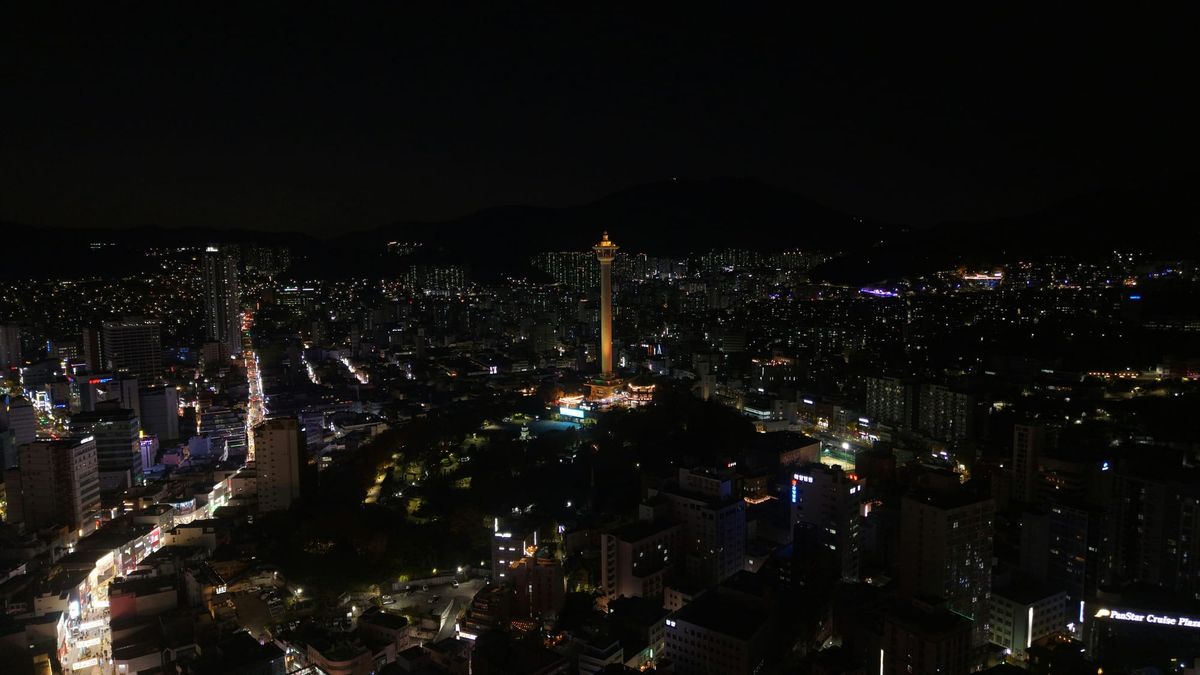
18 Questions for Next Busan · Day 1 of 18
Hyunseung Kim (Gray) · May 17, 2026
Before we begin
In seventeen days, Busan will elect its next mayor.
But the conversation around the election keeps circling the same question — who should be elected — and almost never the larger one beneath it: what kind of Busan are we electing? The televised debates revolve around the familiar shortlist. Property prices. Jobs. Transportation. None of it unimportant. But the question underneath those questions — the one that decides what those policies are actually for — sits unwritten anywhere.
For the next seventeen days, PolyBusan will post one question every day. Not to provide answers — but to put the questions in order. To get them, at minimum, written down.
This is the first one.
What the numbers say
Spring 2026, the facts Busan is facing:
- Number of Korea's top 100 companies headquartered in Busan: zero
- Self-employed business owners: 370,000 in 2021 → 289,000 in 2025. A loss of 81,000 in five years
- Net outflow of people in their 20s, 2016–2025: 50,000
- Population aged 65+: 25.3% — the highest among Korea's seven major metropolitan cities
- Three institutions in this city carry the word "International" in their names — Busan International Finance Center (BIFC), Busan International Film Festival (BIFF), the Port of Busan. All three. International.
These numbers are sad. But sadness is not a policy. You cannot run a city on sadness.
Haeundae, eleven years ago
In June 2015, a small group gathered in a penthouse in Haeundae — a beachside district on Busan's eastern edge, the kind of place foreign visitors usually mean when they say they've been to Busan. The people in the room found Busan compelling, for reasons each of them defined differently. No one declared they were going to shape the city's future. The impulse was simpler than that: gather interesting people in one room and see what happens.
The gathering went by the name Busanloop. The idea inside the name: once Busan catches you, you keep returning.
Eleven years later, the city has changed. So have the people who were in that room. Some left. Some stayed. Some are now preparing their next funding rounds at a lounge on the 22nd floor of BIFC2, in the city's financial district. Some are turning shuttered factories in Yeongdo — a port-side former industrial island — into studios. A new whisky bar opened in Gwangalli, where the city's most photographed bridge frames the sea. And somewhere in a café in Seomyeon last night, someone was coding with Claude Code.
They don't believe Busan is disappearing. They believe Busan is being built.
Two questions inside one
"Why must the next Busan still be Busan?"
The question has two readings.
First — why Busan, of all places
In a city losing young people, losing companies, growing older every year, why do some still try to make things here? In an era when Seoul absorbs almost everything — talent, capital, attention, ambition — why does "Busan" remain a meaningful coordinate at all?
Second — what kind of Busan should it be
A museum built from yesterday's nostalgia? A city where today's builders go to work? A port where tomorrow's arrivals find a reason to stay? It can be all three. But the priorities have to be ordered. Honestly.
The next seventeen days
PolyBusan will split these two questions into seventeen smaller ones, one per day.
Young people. Companies. The sea. The gateway. BIFC. The old downtown. Food. Film. Aging. Foreigners. Design. Education. AI. Housing. Urban form. And, on the last day — who gets to write Busan's next decade.
Not to provide answers. To put the questions in order. Because someone has to answer them, eventually. And we'd rather these questions didn't get buried inside the ballot box on June 3rd.
One small ask
Tomorrow, the second question goes out.
Why do young people leave, and who stays?
If something here resonates, share it with one person — someone who is building Busan, in their own way.
— Gray
Busan, May 2026
PolyBusan does not endorse any party or candidate. We just ask questions.
Corrections, thoughts: busanloop@gmail.com