After Writing Eighteen Essays
Across all eighteen essays, I never once wrote my own name. I believed that when the writer stands ahead of the writing, the question hides behind the person. Now the series is over — so I step out once: why I wrote it, what I learned, and what I will build next in Busan.
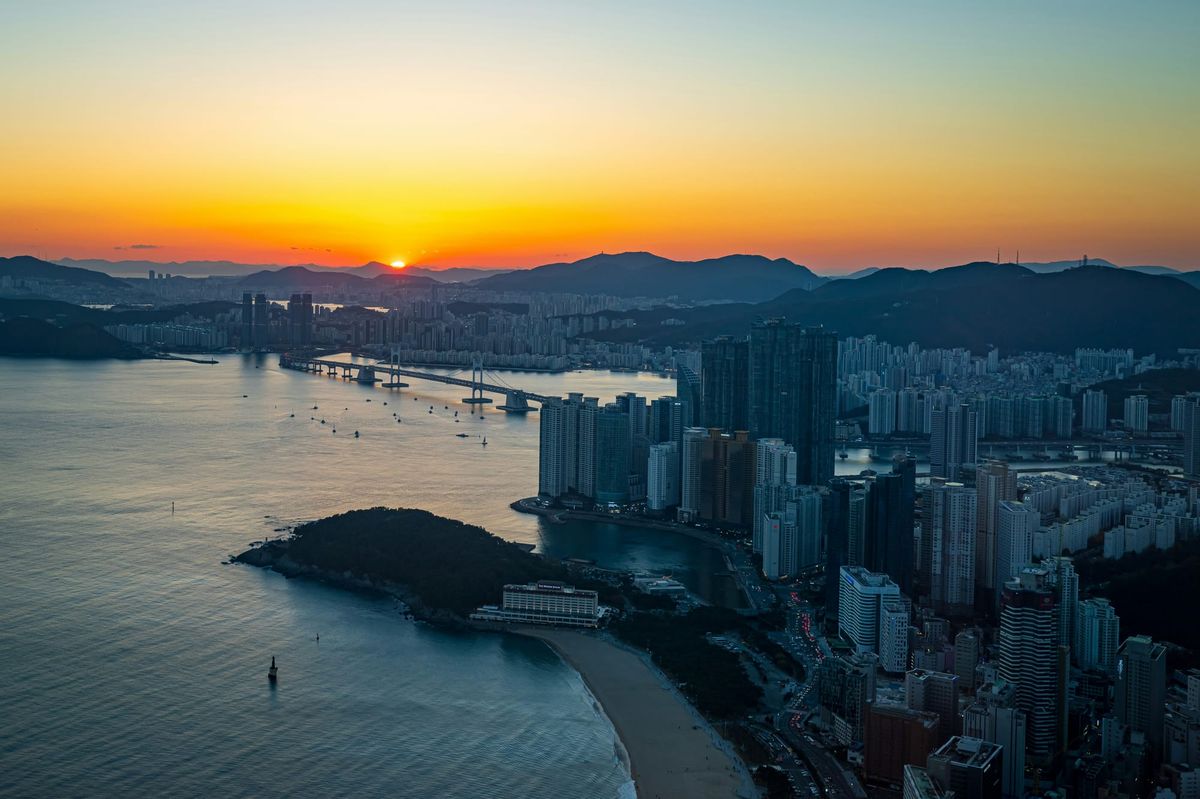
18 Questions for Next Busan — A Retrospective · Gray (Kim Hyunseung) · June 2026
Why I Wrote It
Across all eighteen essays, I never once wrote my own name.
"18 Questions for Next Busan" was a series that asked one question about Busan each day for eighteen days. In Korean and English, thirty-six essays in all. Yet in none of them was there an I. That was deliberate. I believed that when the writer stands ahead of the writing, the question gets hidden behind the person. So I stayed hidden to the end.
Now that the series is over, I want to step out, just once. Because to say why I wrote this, I have to say who I am.
For nearly twelve years I have run a community of builders in Busan. I held startup events, guided people arriving from abroad through the city, and took people from Busan out into the world. Over those twelve years one thought grew steadily clearer. Connection itself is not value. What makes value is the depth of trust that carries through to action. Exchanging business cards, an event that opens once and ends, a dazzling résumé — I watched too many such things fail to change a city.
Busan has often let good things slip away. People, chances, trust that was just beginning to accumulate. As someone who watched it up close, I did not want to let any more slip. When everyone, ahead of an election, spoke only of whom to choose, what I really wanted to ask was which Busan. That is why I wrote these eighteen essays.
How I Wrote It
I am not a developer, not a writer. Not an urban-policy expert either.
And yet for eighteen days I put out one essay daily, in Korean and English, and registered each in an academic database, down to a DOI. It would have been impossible alone. I wrote with AI. Finding sources, refining sentences, carrying them into English, checking the structure — every night, together.
The principles I kept while writing were simple. First, one essay carries one message only. However good a supporting fact, if it blurred that one thing, I cut it. Tempting statistics, fine examples — I threw them out, again and again. Taking away was often the answer.
Second, I do not put myself forward. Not my business, not my career, not my space went into the writing. In one essay I nearly used my own experience as support, but in the end turned it anonymous. What proves an essay is written by someone who has done it is not a name but the density of its sentences — that was what I believed.
Third, I write what does not change. Whoever the mayor becomes, what Busan must build is the same. It was that unchanging thing I wanted to write.
What I Wrote
The eighteen questions looked scattered. Why do the young leave, what is the sea to Busan, what does Busan not measure, whom does Busan recognize as its own, how does it grow and gather and reconnect and accumulate people.
Yet once it was all written, the questions gathered into one. Trust. What Busan did not measure, what it failed to recognize, what was severed with those who left — all of it was trust. And trust begins with one thing. People recognizing people. Seeing who is real, and from there trust grows, trust accumulates into an institution, and the institution outlasts the person.
A thought I had held only vaguely was, across eighteen essays, set down in a single line. Before writing, it was not this clear. Only in writing did I come to know it. The series was for the reader, but the one who learned the most was me.
What I Do Now
The eighteen essays were questions. The questions are done. What remains now is to build.
Building recognition into trust, and trust into an institution, does not happen through writing. It happens in a place, between one person and another, over time. I mean to do that work. I have not yet drawn out the whole of how, but the direction is clear. To place Busan back inside the network of the world's port cities. To connect those who left as the city's points around the world, and to build the place where those who arrive can stay.
I am a builder. For twelve years I have built people and community in Busan, and what lies ahead is, in the end, also building. I stayed hidden while writing the eighteen essays, but building cannot be done in hiding. A builder has to stand beside the thing they build. So with this retrospective, I write my name for the first time.
Now, in Busan, I begin to rebuild.
And I will keep writing the process here. This time, not as questions, but as the story of building.
It begins in Busan. It does not end in Busan. This time, we will not let it slip away.
18 Questions for Next Busan — A Retrospective